

Cow dung is one of the most widely available organic residues generated by cattle farms, dairy farms, livestock operations, and animal husbandry facilities. As the scale of cattle farming increases, the amount of manure generated every day can also become substantial. Without an appropriate utilization and management system, large quantities of cow dung can create challenges related to storage, transportation, handling, and environmental management.
Cow dung pelletizing is one method of processing this organic material into compact and more uniform pellets. Depending on the formulation and final application, the pellets can be produced as organic fertilizer pellets or, after appropriate testing and processing, biomass fuel products.
The cow dung pelletizing process is not simply a matter of putting fresh manure into a pellet mill. Fresh cow dung normally contains too much moisture and has an irregular structure for direct pelletizing. It may first require cleaning, composting or fermentation, drying, crushing, mixing, and moisture adjustment before entering the pelletizing machine.
A complete process may include:
Cow Dung Collection → Cleaning → Composting/Fermentation → Drying → Crushing → Mixing → Moisture Adjustment → Pelletizing → Cooling → Screening → Packaging
The exact process depends on the raw material, required capacity, pellet diameter, formulation, and final application.
This article explains the complete cow dung pelletizing process, the purpose of each stage, the equipment involved, and how a cow dung pellet machine works in the production line.
What Is Cow Dung Pelletizing?
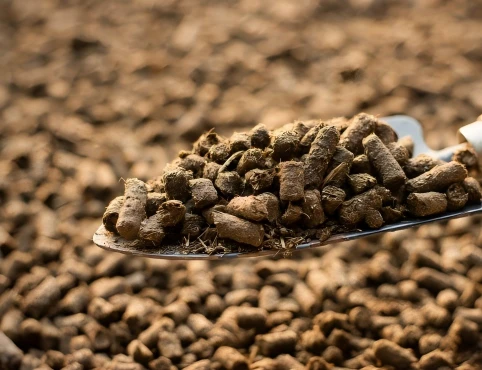
Cow dung pelletizing is the process of compressing prepared cattle manure into small cylindrical pellets.
Pelletizing changes the physical form of loose manure.
Compared with untreated manure, pellets can be easier to:
- Store
- Transport
- Package
- Handle
- Dose
- Apply
For fertilizer applications, pelletizing can create a more standardized product that is easier to distribute and sell.
For fuel applications, cow dung or manure-based mixtures require additional evaluation because ash content, moisture, calorific value, and combustion characteristics can vary significantly.
Therefore, the intended application should be determined before designing the production process.
Why Is Cow Dung Pelletized?
There are several reasons why farms and fertilizer manufacturers may choose to pelletize cow dung.
Easier Storage
Loose manure takes up considerable space and can be difficult to organize.
Pelletizing produces a compact material that can be stored in bags, bulk containers, or warehouses.
Easier Transportation
Pellets have a standardized shape and higher bulk density than loose manure, making them easier to transport.
Better Product Handling
Pellets can be handled using conveyors, elevators, bagging equipment, and other material-handling systems.
Commercial Fertilizer Production
Cow dung can be processed into organic fertilizer pellets and packaged as a standardized agricultural product.
Better Resource Utilization
Instead of treating manure only as waste, pelletizing provides a route for converting it into a usable product.
Step 1 Collect the Cow Dung
The first stage of the process is manure collection.
Cow dung can be collected from:
- Dairy farms
- Beef cattle farms
- Livestock farms
- Cattle barns
- Feedlots
- Animal husbandry facilities
The collection method depends on the farm design.
Manual collection may be suitable for small farms, while larger facilities may use mechanical scraping, manure pumps, conveyors, or other collection systems.
The collected material should be transferred to a designated processing area.
At this stage, the operator should also evaluate the raw material.
Important properties include:
- Moisture content
- Organic matter
- Foreign material content
- Fiber content
- Bedding material
- Nutrient composition
This information helps determine the downstream process.
Step 2 Remove Foreign Materials
Raw cow dung may contain materials that should not enter the pelletizing system.
Possible contaminants include:
- Stones
- Sand
- Metal pieces
- Plastic
- Wood
- Excess bedding
- Other foreign objects
Large foreign materials can damage crushers, mixers, conveyors, and pellet mills.
A cleaning or screening system can be installed at the beginning of the production line.
Magnetic separation can also be considered when there is a risk of ferrous metal contamination.
The cleaner the raw material, the easier it is to protect downstream equipment.
Step 3 Compost or Ferment the Cow Dung
For organic fertilizer pellet production, composting or fermentation can be an important pretreatment stage.
Fresh cow dung is biologically active and contains considerable moisture. Composting allows organic matter to decompose under controlled conditions.
A typical composting process may involve:
- Mixing manure with appropriate organic materials.
- Adjusting moisture.
- Creating suitable aeration.
- Turning the material regularly.
- Monitoring temperature.
- Allowing the material to stabilize.
A compost turner can be used in larger commercial fertilizer plants.
The purpose is not simply to dry the manure but to create a more stable organic material suitable for further processing.
The required composting time depends on the raw material and process design.
Step 4 Dry the Cow Dung
Drying is one of the most important steps in cow dung pellet production.
Fresh or partially composted manure usually contains more moisture than the pellet mill can process efficiently.
Excessive moisture can result in:
- Soft pellets
- Die blockage
- Unstable feeding
- Lower production
- Increased energy consumption
- Poor pellet durability
An industrial rotary dryer machine can be used for large-scale processing.
A typical drying system may include:
- Feeding conveyor
- Rotary drum
- Hot air furnace
- Fan
- Cyclone
- Dust collector
- Exhaust system
- Temperature monitoring
The dryer should be selected according to the initial moisture, required production capacity, and target moisture.
The goal is not to remove all moisture. Instead, the material should reach a suitable condition for pelletizing.
Step 5 Crush the Dried Cow Dung
After drying, cow dung may form hard lumps or contain irregular particles.
A crusher breaks these lumps into smaller pieces.
Common equipment may include:
- Vertical crusher
- Hammer mill
- Organic fertilizer crusher
- Fine grinder
The purpose of crushing is to improve particle uniformity before mixing and pelletizing.
A relatively uniform material allows the pellet mill to compress the feedstock more consistently.
If the material contains long fibers or other coarse organic matter, additional grinding may be required.
Step 6 Mix the Cow Dung
Cow dung does not always need to be pelletized alone.
For fertilizer production, it can be mixed with other organic or mineral materials to create a specific formulation.
Possible ingredients include:
- Crop residues
- Compost
- Straw
- Other livestock manure
- Organic fertilizer materials
- Suitable mineral nutrients
A mixer helps distribute the materials evenly.
Common mixer types include:
- Horizontal mixer
- Vertical mixer
- Double-shaft mixer
- Paddle mixer
The choice depends on the material characteristics and production capacity.
Uniform mixing is important because it helps ensure that each pellet has a relatively consistent composition.
Step 7 Adjust Moisture Before Pelletizing
After mixing, moisture should be checked again.
Moisture is a key factor in pellet formation.
If the material is too wet, it may become sticky and difficult to compress.
If it is too dry, the particles may not bind together effectively.
Therefore, the production line may require additional water addition or drying depending on the actual material condition.
Moisture should be measured rather than estimated only by appearance.
The optimal moisture level depends on:
- Cow dung composition
- Additional ingredients
- Particle size
- Pellet diameter
- Die compression ratio
- Pellet machine design
Step 8 Feed the Material Into the Pellet Machine
Once the material is properly prepared, it is transported to the pelletizing section.
A feeding hopper and screw feeder can provide a stable supply.
Stable feeding is important because sudden changes in material flow can affect pellet mill load and pellet quality.
The feeding system may include:
- Hopper
- Screw conveyor
- Variable-speed feeder
- Agitator
- Level sensor
- Automatic control
For larger plants, the feeding system can be connected to a centralized control system.
Step 9 Use a Cow Dung Pellet Machine
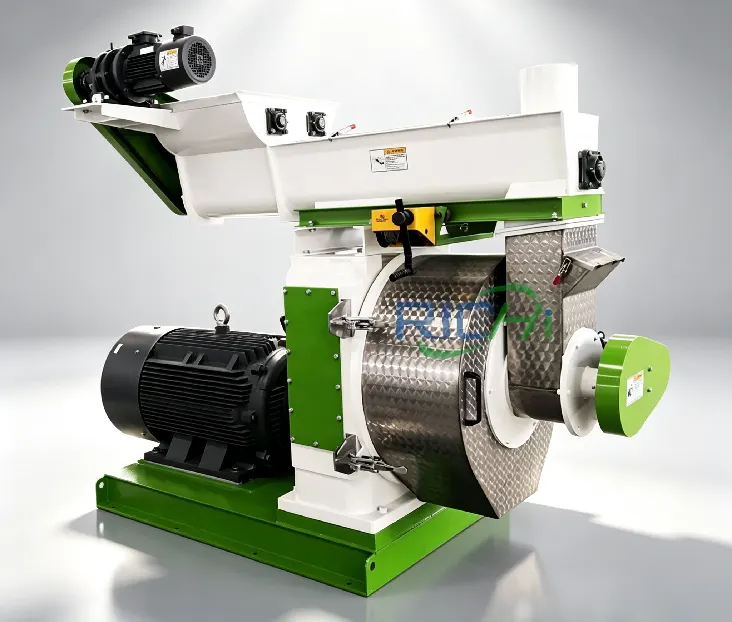
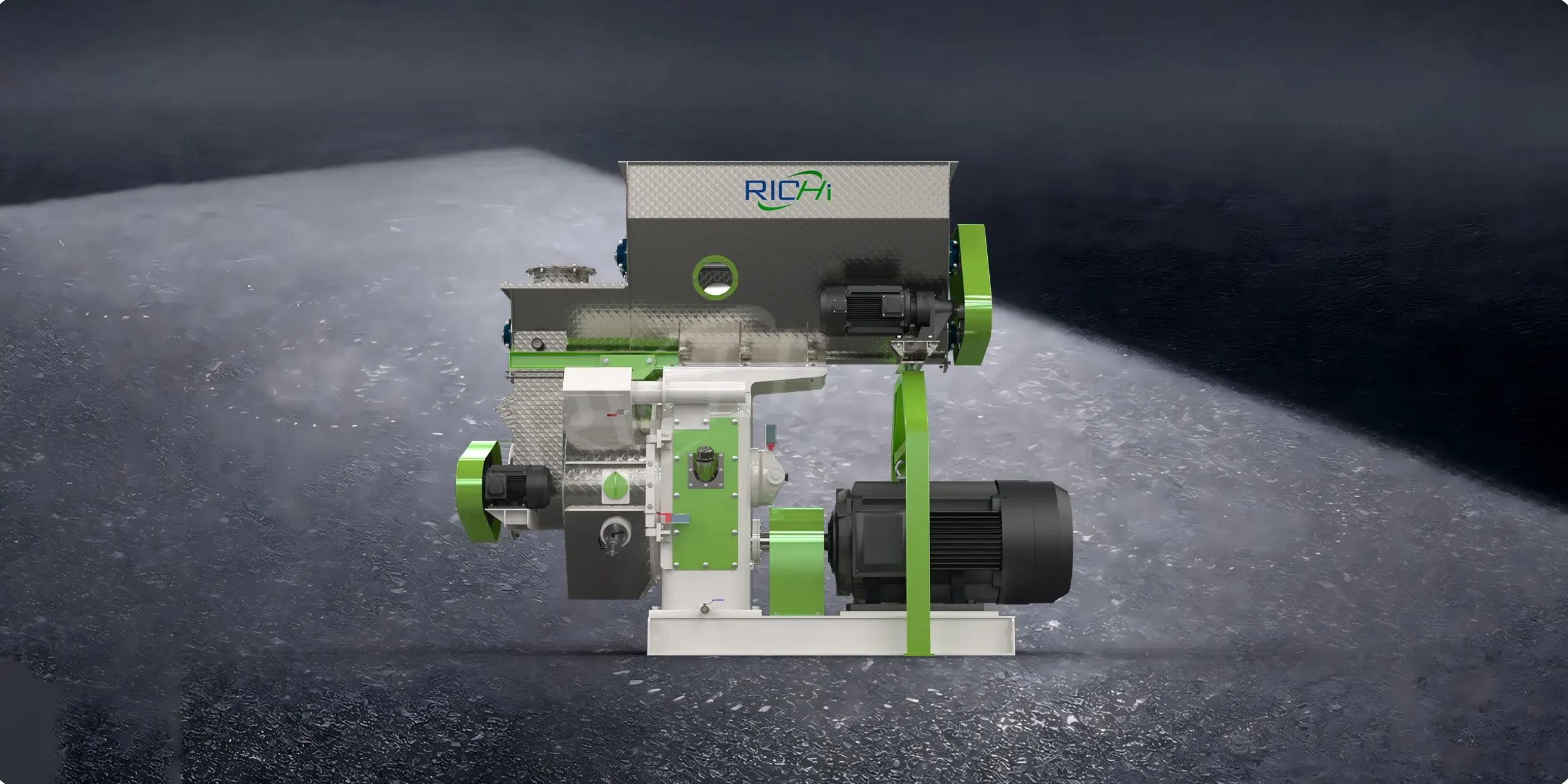
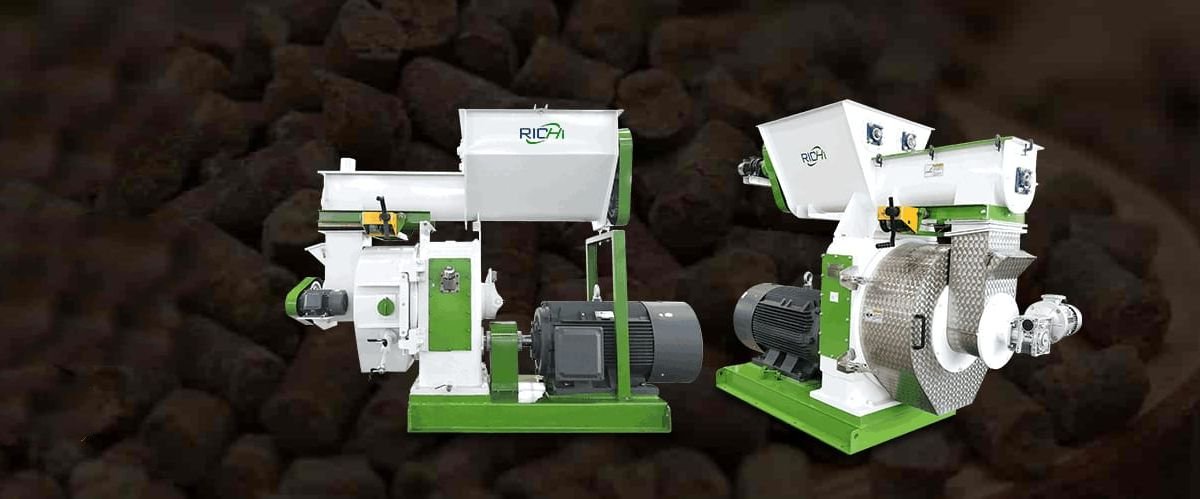
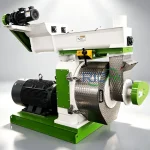
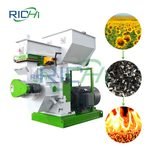
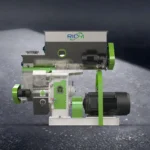
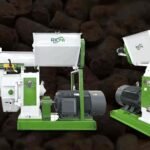
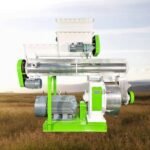
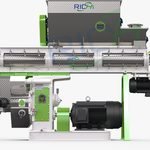
The cow dung pellet machine is the core equipment used to form prepared cow dung into pellets.
The basic pelletizing principle is compression.
Prepared material enters the compression chamber. Rollers press the material against a rotating die. Under pressure, the material is forced through holes in the die.
The compressed material exits the die as continuous strands.
A cutting system then divides these strands into pellets of the required length.
The main components include:
- Die
- Rollers
- Main shaft
- Compression chamber
- Feeding system
- Drive system
- Lubrication system
- Safety system
For commercial fertilizer pellet production, ring die pellet mills can be used when continuous production and higher capacity are required.
How Does the Cow Dung Pellet Machine Work?
The pelletizing process can be understood through several stages.
Feeding
Prepared material enters the pelletizing chamber.
Compression
The rollers compress the material against the die.
Extrusion
The material is pushed through the die holes.
Pellet Formation
Continuous compressed strands emerge from the die.
Cutting
The strands are cut into pellets.
The quality of the final pellets depends on the interaction between raw material preparation and machine parameters.
Important variables include:
- Moisture
- Particle size
- Feed rate
- Die compression ratio
- Roller condition
- Roller clearance
- Pellet diameter
- Production speed
(Learn more:https://richipelletizer.com/cow-dung-pellet-making-machine/)
Step 10 Select the Right Pellet Die
The die determines the basic diameter of the pellets.
Different applications may require different pellet sizes.
For organic fertilizer products, pellet diameter can be selected according to:
- Crop application
- Spreading equipment
- Packaging requirements
- Customer preference
- Product formulation
The compression ratio is also important.
If the die is not suitable for the material, the pellet machine may experience:
- Low output
- High energy consumption
- Die blockage
- Poor pellet durability
- Increased wear
Therefore, die selection should be based on the characteristics of the cow dung mixture.
Step 11 Cool the Fresh Pellets
Fresh pellets leaving the pellet machine can be hot.
They should normally be cooled before screening and packaging.
A counterflow pellet cooler can reduce pellet temperature and stabilize the product.
Cooling can help:
- Reduce temperature
- Remove residual moisture
- Improve pellet hardness
- Reduce condensation
- Improve storage stability
For commercial fertilizer production, proper cooling is especially important when pellets are packed shortly after production.
Step 12 Screen the Cow Dung Pellets
After cooling, the pellets are passed through a vibrating screen.
The screening process separates qualified pellets from:
- Fine powder
- Broken pellets
- Oversized material
- Unwanted particles
Qualified pellets continue to packaging.
Fine material can often be recycled into the pelletizing process, depending on the formulation.
Screening helps improve the physical consistency of the final product.
Step 13 Package the Finished Pellets
The final stage is packaging.
Depending on the market, cow dung fertilizer pellets can be packaged in:
- Small bags
- Woven bags
- Large bags
- Bulk containers
Automatic packing machines can weigh and package the pellets at a consistent rate.
Packaging also protects the pellets from moisture during transportation and storage.
For commercial fertilizer products, bags may include information such as:
- Product name
- Net weight
- Nutrient analysis
- Recommended application
- Storage instructions
- Manufacturer information
Specific labeling requirements depend on local regulations.
Complete Cow Dung Pelletizing Process Flow
A typical commercial cow dung fertilizer pellet production line can be organized as follows:
Cow Dung Collection
↓
Cleaning and Foreign Material Removal
↓
Composting or Fermentation
↓
Drying
↓
Crushing
↓
Mixing
↓
Moisture Adjustment
↓
Cow Dung Pelletizing
↓
Cooling
↓
Screening
↓
Packaging
This process can be modified according to the actual properties of the manure and the requirements of the final product.
What Equipment Is Used in Cow Dung Pelletizing?
A complete production line may include several machines.
Compost Turner
Used to turn and aerate cow dung during composting.
Dryer
Reduces excessive moisture before pelletizing.
Crusher
Breaks dried manure into smaller particles.
Mixer
Combines cow dung with other raw materials.
Cow Dung Pellet Machine
Compresses prepared material into pellets.
Pellet Cooler
Reduces the temperature of fresh pellets.
Vibrating Screen
Separates qualified pellets from fines.
Packing Machine
Weighs and packages the final product.
Conveyor
Moves materials between processing stages.
Dust Collection System
Collects dust generated during crushing, screening, and material handling.
The equipment configuration should be selected according to the production capacity and raw material characteristics.
How Moisture Affects Cow Dung Pelletizing
Moisture is one of the most important variables in the process.
If the material contains too much water:
- Pellets may become soft.
- The die may become blocked.
- Feeding may become unstable.
- Energy consumption may increase.
If the material is too dry:
- Pellet formation may become difficult.
- More fines may be produced.
- Pellet durability may decrease.
The appropriate moisture condition depends on the material composition and pellet machine.
For this reason, moisture should be measured at multiple stages.
How Particle Size Affects Pellet Formation
Particle size also influences pellet quality.
If the material is too coarse:
- Compression may become uneven.
- Pellets may contain cracks.
- Die feeding may become less stable.
If the material is excessively fine:
- Grinding energy may increase.
- Dust generation may increase.
- Production costs may rise.
The objective is to achieve a particle size distribution that allows efficient compression without unnecessary grinding.
How to Improve Cow Dung Pellet Quality
Several factors should be controlled.
Maintain Suitable Moisture
Moisture should remain within the appropriate operating range.
Use Consistent Particle Size
Crushing and grinding should produce relatively uniform particles.
Maintain Stable Feeding
The pellet machine should receive a consistent material flow.
Select a Suitable Die
Die diameter and compression ratio should match the material.
Maintain Rollers
Worn rollers can negatively affect pellet formation.
Cool Properly
Fresh pellets should be cooled before packaging.
Screen Effectively
Remove excessive fines and broken pellets.
Common Problems in the Cow Dung Pelletizing Process
Pellets Are Too Soft
Possible causes include excessive moisture or insufficient compression.
Pellets Break Easily
Possible causes include unsuitable moisture, poor particle size distribution, or incorrect die selection.
Die Blockage
This may result from excessive moisture or unsuitable material preparation.
Low Production Capacity
The bottleneck may be caused by the dryer, crusher, feeder, pellet machine, or cooler.
Excessive Fines
Poor compression, unsuitable moisture, or insufficient screening can increase fines.
Uneven Pellet Size
Unstable feeding or incorrect cutting settings can result in inconsistent pellet dimensions.
Solving these problems requires looking at the complete production process rather than focusing only on the pellet mill.
How to Choose a Cow Dung Pellet Machine
Before purchasing a pellet machine, several factors should be evaluated.
Production Capacity
Determine how much cow dung is available per hour or per day.
Pellet Diameter
Select the pellet size according to the final application.
Raw Material Moisture
Measure the moisture content before and after drying.
Raw Material Composition
Determine whether cow dung will be pelletized alone or mixed with other materials.
Automation Level
Decide whether manual, semi-automatic, or fully automatic operation is required.
Maintenance Requirements
Check the availability and replacement method of wear parts such as dies and rollers.
Complete Line Compatibility
Make sure the pellet machine capacity matches the dryer, crusher, mixer, cooler, and packaging system.
(investigate this site:RICHI PELLETIZER)
Cow Dung Pelletizing for Organic Fertilizer
The most common application of pelletized cow dung is organic fertilizer.
Pelletizing can make manure easier to commercialize by providing a standardized physical form.
A fertilizer producer can develop different formulations according to crop and market requirements.
For example, the producer may combine cow dung with other organic materials to adjust:
- Organic matter
- Nutrient content
- Moisture
- Pellet hardness
- Pellet diameter
The exact formulation should be determined based on laboratory analysis and product requirements.
Can Cow Dung Pellets Be Used as Fuel?
Cow dung contains organic matter and can have some energy value, but fuel applications require careful testing.
Important parameters include:
- Moisture
- Ash content
- Calorific value
- Volatile matter
- Fixed carbon
- Combustion behavior
- Mineral composition
- Contaminants
Manure-based fuel may have a higher ash content than conventional wood pellets.
Therefore, the intended combustion equipment should be evaluated before commercial fuel production.
In some cases, cow dung can be blended with other biomass materials to modify its fuel characteristics.
Why a Complete Turnkey Cow Dung Pellet Plant Matters
A pellet machine alone cannot solve every processing challenge.
For example, if the dryer does not provide enough dried material, the pellet machine cannot reach its designed capacity.
Similarly, if the crusher produces inconsistent material, pellet quality may become unstable.
A complete turnkey system integrates:
Drying + Crushing + Mixing + Pelletizing + Cooling + Screening + Packaging
This allows each machine to be selected according to the capacity and requirements of the complete process.
For large livestock farms and fertilizer manufacturers, integrated engineering can also simplify installation, commissioning, training, and maintenance.
Cow Dung Pelletizing and Waste Resource Utilization
The main purpose of cow dung pelletizing is to improve the utilization of livestock manure.
Instead of handling manure only as loose waste, a pellet production system can convert it into a standardized product.
The overall concept is:
Livestock Production → Cow Dung → Processing → Pelletizing → Organic Fertilizer
This approach can help create additional value from agricultural residues.
For farms that generate large quantities of manure, pelletizing may also provide a more organized method of handling and marketing the material.
Conclusion
The cow dung pelletizing process is a multi-stage system that transforms loose livestock manure into compact and standardized pellets.
The complete process may include cow dung collection, cleaning, composting or fermentation, drying, crushing, mixing, moisture adjustment, pelletizing, cooling, screening, and packaging.
The cow dung pellet machine is the central equipment that compresses prepared material into pellets, but its performance depends heavily on the quality of the material entering the machine. Moisture, particle size, formulation, feeding stability, die compression ratio, roller condition, and cooling all influence the final product.
For organic fertilizer production, cow dung pellets can provide advantages in storage, transportation, packaging, handling, and application. For fuel applications, additional testing is necessary to determine whether the material meets the requirements of the intended combustion system.
A successful cow dung pelletizing project should therefore be designed as a complete production line rather than as a single-machine purchase. By matching drying, crushing, mixing, pelletizing, cooling, screening, and packaging equipment to the raw material and production target, livestock manure can be transformed into a more manageable and potentially valuable pellet product.