



Rice husks are one of the most abundant agricultural residues in the world. For every ton of rice milled, roughly 200 kilograms of husk are produced. Global rice production generates tens of millions of tons of husk every year. In theory, that is an enormous energy resource. In practice, most of it is dumped, burned in the open, or left to rot.
The problem is not that rice husk has no value. It has energy content, it is dry, and it is produced in one place, which makes collection easier than many other residues. The problem is that rice husk behaves badly in nearly every piece of equipment used to process it. It is abrasive, it is lightweight, it bridges in hoppers, it does not bind well during pelleting, and it leaves behind ash that can cause problems in combustion systems.
A rice husk pellet mill is built to handle these difficulties, but it cannot overcome them alone. The economics of rice husk pelleting depend on where the husk comes from, how far it has to travel, how it is dried, how the mill is configured, and what market exists for the finished pellets.
This article looks at rice husk as a fuel feedstock from a practical standpoint. It covers why rice husk is difficult, what equipment is needed, how small-scale operations work, and what project developers should consider before investing.
Where Rice Husk Comes From
Rice husk is a by-product of rice milling. Paddy rice arrives at a mill with the husk still attached. The milling process removes the husk to produce brown rice, which is then polished or processed further.
Because husk is produced at the mill, it is concentrated rather than scattered. A single rice mill can generate several tons of husk per day. That concentration is an advantage for pellet production, because collection is simpler than for residues that are spread across fields.
The disadvantage is location. Rice mills are not always close to pellet markets or to power infrastructure. Husk that is produced in a remote area may be cheap, but moving it or the finished pellets to market can be expensive.
Rice husk is also seasonal in some regions, depending on when the rice harvest occurs. Mills may operate year-round, but the volume of husk produced varies. Storage is needed to buffer against seasonal swings.
Why Rice Husk Is Difficult to Pelletize
Rice husk is one of the harder biomass materials to pelletize, for several reasons.
The first is abrasiveness. Rice husk contains high levels of silica, which is extremely hard. It wears dies, rollers, and hammers faster than almost any other common biomass feedstock. Die life can be measured in weeks rather than months.
The second is bulk density. Rice husk is very light and fluffy. It does not flow well, and it bridges in hoppers and feeders. Material handling equipment has to be designed for this behavior, not adapted from systems built for grain or wood chips.
The third is binding. Rice husk does not contain much lignin compared to wood, and what it does contain is bound up in a structure that resists softening. That makes it harder to form durable pellets without additives or high pressure.
The fourth is ash content. Rice husk produces a lot of ash when burned, often 15 to 20 percent by weight. That ash is also high in silica, which can form slag and fouling in boilers not designed for it.
The fifth is moisture variability. Husk from different mills, or stored under different conditions, can vary widely in moisture content. That makes process control harder.
None of these problems is unsolvable. But each one adds cost, and projects that do not account for them tend to underperform.
Preparing Rice Husk for Pelleting
Rice husk requires less preparation than many other biomass materials, but the preparation it does need matters.
Collection comes first. Husk is collected from rice mills, either in bulk or in bags. Bulk handling is cheaper at scale, but it requires the mill to have appropriate loading equipment.
Storage follows. Husk should be kept dry. It absorbs moisture readily, and wet husk molds quickly. Covered storage is preferable, though some operations use tarps or well-drained piles.
Grinding is usually not required, because husk is already small. However, some operations grind husk to improve pellet quality or to blend it with other materials. Grinding husk is energy-intensive and wears hammers quickly.
Drying may be required if moisture is above the target range. Husk from a freshly milled batch can be wetter than expected, especially in humid climates. Rotary dryers are common in larger operations.
Pelleting is the core step. Because husk does not bind well on its own, some operations blend it with a binder or with another biomass material that has higher lignin content. Others use higher pressure and specially designed dies. The choice depends on the target pellet quality and the market.
Cooling follows. Fresh pellets are hot and moist. They must be cooled before storage or bagging.
Screening and bagging complete the process. Fines are separated and recycled.
Equipment Selection for Rice Husk
Rice husk places specific demands on equipment, and general-purpose machines may not perform well without adjustment.
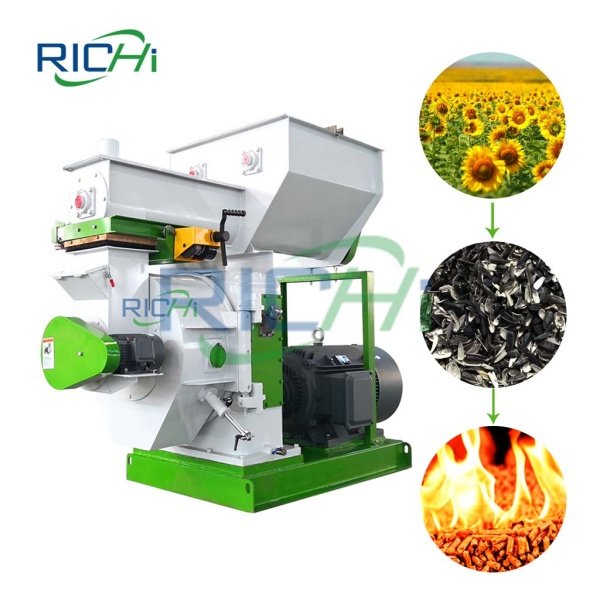
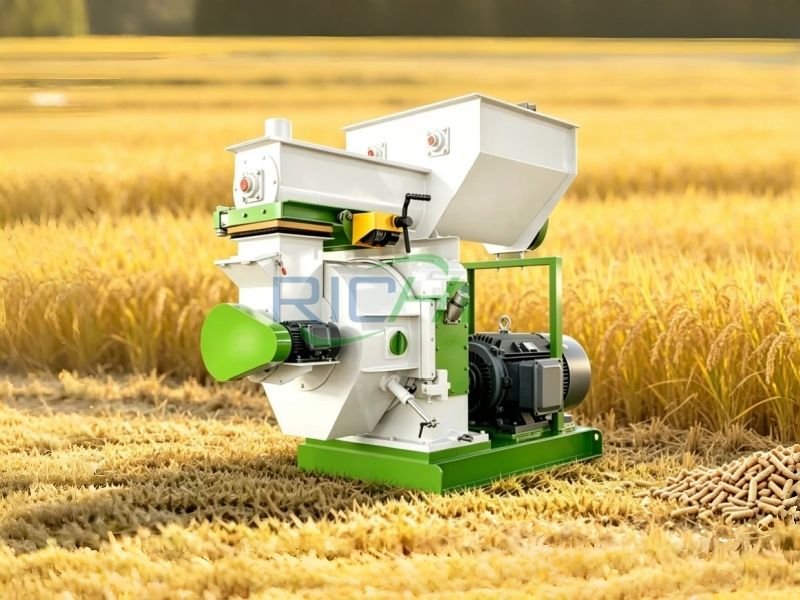
The pellet mill itself has to handle abrasive material. Ring die mills are usually preferred for biomass because they handle high volumes and produce more uniform pellets. For rice husk, die material and compression ratio matter more than usual. Wear-resistant dies extend replacement intervals and reduce downtime.
Grinding equipment may not be needed, but if it is, hammers and screens must be wear-resistant. Rice husk is abrasive even in its raw form.
Drying equipment should be sized for the wettest material likely to be received. Husk moisture varies, so drying capacity should be based on the worst case, not the average.
Cooling equipment should be effective, because rice husk pellets retain heat longer than some other biomass pellets.
Material handling equipment is often the most underestimated part of the system. Rice husk is light and does not flow well. Conveyors, bins, and feeders have to be designed for the material.
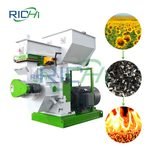
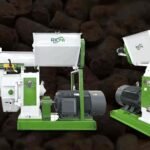
For small-scale operations, a 1.5t/h small rice husk pellet mill for sale is a common specification. At this scale, the line is large enough to be meaningful but small enough to be managed by a single mill or cooperative. Buyers should confirm that the mill is rated for rice husk specifically, not just for biomass in general, because the demands are different.
Drying and Moisture Control
Moisture control is critical in rice husk pelleting, even though husk is often drier than other residues.
The target moisture for pelleting is usually 12 to 15 percent. Material that is too dry will not bind well. Material that is too wet will produce soft pellets and may clog the die.
Husk from a freshly milled batch can be wetter than expected. Husk stored outdoors can absorb moisture. In both cases, drying is necessary.
Drying cost depends on the starting moisture, the target moisture, and the energy source. In regions with cheap biomass fuel, drying is more affordable. In regions with expensive fuel, it can dominate operating cost.
Storage moisture matters too. Husk that is stored wet will mold, which reduces fuel value and creates health hazards. Covered storage and proper drainage are essential.
Market and Economics
Rice husk pellets can be sold into several markets, each with different requirements.
Industrial boilers are one. Rice husk pellets can be co-fired with coal or used in dedicated biomass boilers, provided the boiler is designed for high-ash fuel. Industrial buyers usually purchase large volumes and pay less per ton.
Residential heating is another. Rice husk pellets can be used in some stoves and boilers, but high ash content limits acceptance in many markets.
Export is a third option. Some regions export biomass pellets to Europe or Asia. Export requires meeting quality standards and competing on price.
On-site use is a fourth option. A rice mill can use its own husk to produce pellets for heat or power, avoiding transport and market risk. This is often the most economical option for small operations.
The economics of rice husk pelleting depend on feedstock cost, processing cost, and product value. Feedstock cost is often low because husk would otherwise be wasted. Processing cost depends on moisture, die wear, and energy. Product value depends on the market.
Richi Manufacture is one supplier that produces pellet equipment for biomass applications and works with project developers on equipment selection and line configuration. For projects that want to understand how a supplier approaches system design and long-term support, more detail is available if you go straight from the source to see how turnkey projects are structured.
Environmental Benefits
Turning rice husk into pellets has clear environmental benefits.
It reduces open burning, which is common in many rice-producing regions and causes serious air pollution. It reduces landfill waste. It provides a renewable fuel that can replace coal or gas. And it uses a material that would otherwise be wasted.
There are limits, however. Rice husk ash is high in silica and can be difficult to dispose of. Some of it can be used in construction materials or as a soil amendment, but not all. And the energy used in processing reduces the net carbon benefit if it comes from fossil fuels.
A responsible project accounts for these factors. It manages ash disposal and uses renewable energy where possible.
Common Mistakes
Several mistakes appear repeatedly in rice husk pelleting projects.
Underestimating die wear is the most common. Rice husk is extremely abrasive. Dies wear faster than with almost any other biomass feedstock. Budgets that assume wood-level die life are unrealistic.
Ignoring material handling is another. Rice husk is light and does not flow well. Conveyors, bins, and feeders have to be designed for the material.
Underestimating drying is a third. Husk moisture varies. Drying capacity has to match the actual moisture content, not an optimistic estimate.
Skipping market research is a fourth. Producing pellets is not the same as selling them. Projects that do not identify a market end up with inventory they cannot move.
Underestimating ash issues is a fifth. Rice husk pellets produce more ash than wood pellets. Boilers and stoves have to be able to handle it.
What a Realistic Project Looks Like
A realistic rice husk pelleting project starts with the husk, not the machine. It confirms that enough material can be collected at acceptable cost. It plans storage and drying for real-world moisture conditions. It selects a mill and die matched to rice husk. It budgets for wear parts and maintenance. It identifies a market before production begins.
The equipment is important, but it is not the starting point. The starting point is the material and the system that delivers it to the mill.
For projects that want to compare equipment options and understand what a complete biomass pellet line involves, the biomass pellet machine page is a useful reference: https://pelletmakermachine.com/biomass-pellet-machine/
Looking Ahead
Rice husk is an underused resource. It is produced in large volumes at rice mills, it has energy value, and it is often wasted. Pelleting offers a way to turn it into a product that can be stored, transported, and sold.
The technology is established. The equipment is available. What separates successful projects from unsuccessful ones is planning. Collection, moisture, die selection, maintenance, and market access all have to be addressed before the first pellet is made.
For project developers willing to do that work, rice husk pelleting can be a practical addition to a biomass portfolio. For those who skip the planning, the husk will keep piling up while the machine sits idle.