

The global narrative around agricultural waste has shifted dramatically. Where paddy husk was once regarded as a disposal problem — burned in open fields, dumped in waterways, or stockpiled until it spontaneously combusted — it is now increasingly understood as a circular bioeconomy resource. The calorific energy stored in rice husk represents a renewable fuel source that, when processed into standardised pellets, can displace fossil fuels at industrial scale while generating income streams for rural communities and reducing the open burning that contributes to regional air quality crises across South and Southeast Asia.
The technology that enables this transformation is not exotic. It is mechanical engineering applied with appropriate specification to the specific properties of a challenging feedstock. This article explores that technology through the lens of sustainability, operational best practice, and the practical decisions that determine whether a husk pellet operation delivers on its environmental and commercial promise.
The Carbon and Sustainability Case for Rice Husk Pellets
Rice husk pellet combustion is classified as carbon-neutral under international energy accounting frameworks including the IPCC guidelines and the EU Renewable Energy Directive, because the CO₂ released during combustion was sequestered from the atmosphere during the growing season of the rice plant. The lifecycle carbon intensity of rice husk pellets — accounting for processing energy, transportation, and combustion — is typically 85–95% lower than coal on an energy-equivalent basis.
This carbon advantage creates tangible financial value in markets with carbon pricing mechanisms. In the European Union, biomass energy displacing coal at installations subject to the EU Emissions Trading System saves the facility operator €50–100 per tonne of CO₂ avoided. For a 5 T/H plant supplying an industrial boiler running 6,000 hours annually, this represents €150,000–€300,000 of annual carbon cost avoidance for the customer — a compelling selling point that supports premium pricing for certified husk pellets.
The Machine at the Centre of the Value Chain
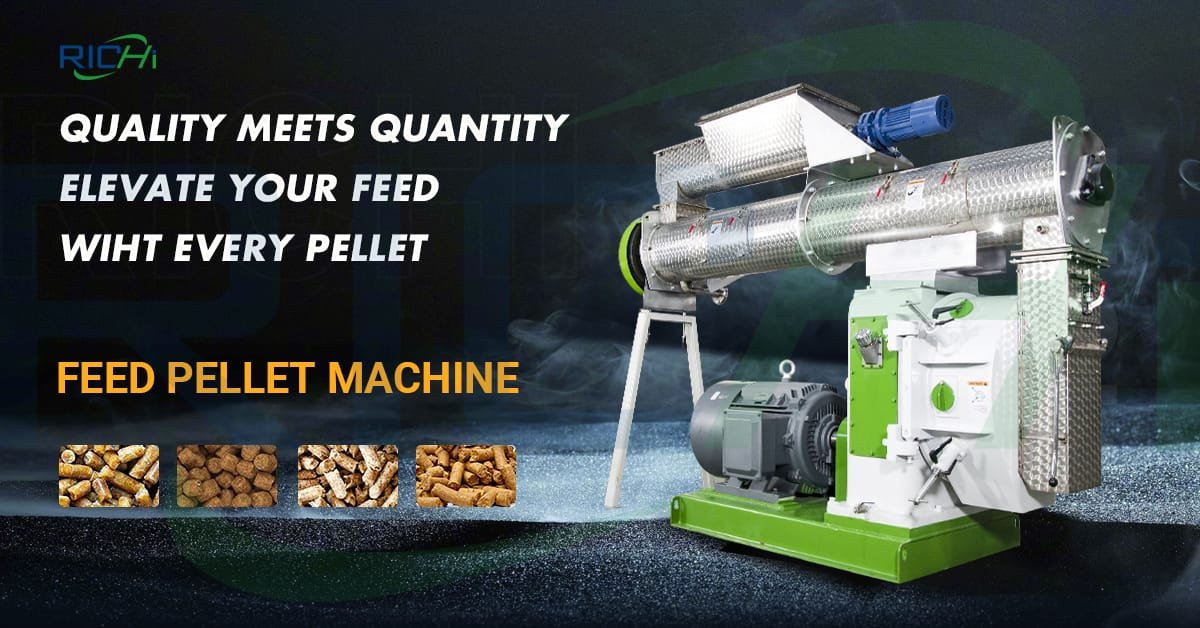
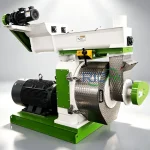
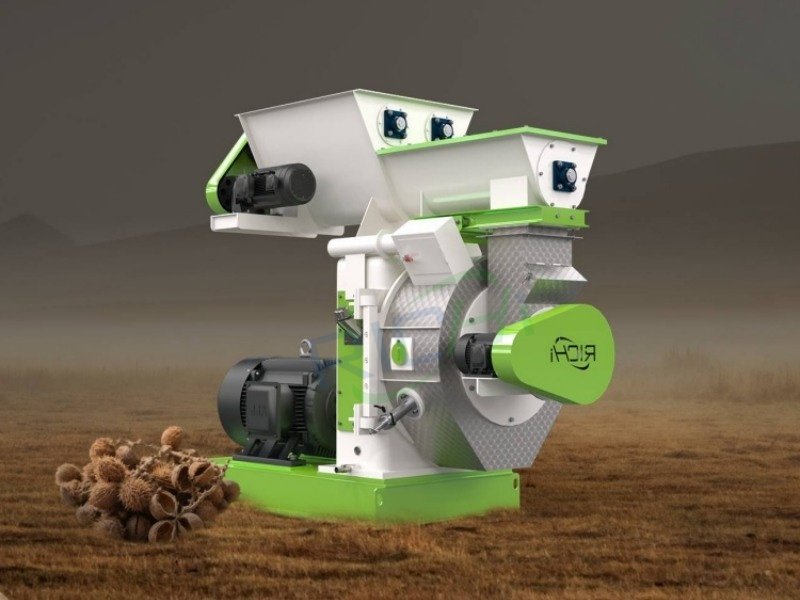
Understanding the mechanics of a husk pellet making machine — how it converts loose agricultural residue into dense, standardised energy carriers — is important context for both the plant developer and the sustainability analyst. The physics can be summarised as follows:
Loose rice husk has a bulk density of approximately 100–120 kg/m³. Finished pellets achieve 600–750 kg/m³. This sixfold density increase is achieved entirely through mechanical compression — no chemical binders, no additives. The natural lignin in rice husk (present at 10–15%) softens under the frictional heat generated in the die channel (80–120°C) and flows to fill inter-particle voids. When the compressed material exits the die and cools, this lignin re-solidifies, binding the pellet structure permanently.
The elegance of this process — using only the material’s own chemistry, no external inputs — means rice husk pellet production has a clean sustainability profile throughout the supply chain. The energy input is entirely electrical; the feedstock is entirely waste-derived; the product is entirely combustible with minimal non-combustible residue.
Technology Selection for High-Throughput Operations
For operations targeting 5–6 T/H output — the level at which industrial energy buyers typically begin viewing a supplier as a meaningful long-term partner — a 5-6 T/H industrial rice husk pellet maker must be specified with the following performance parameters as contractual minimums, not aspirational targets:
- Continuous throughput on rice husk (not sawdust or general biomass): ≥5.0 T/H measured over 8-hour test run
- Pellet bulk density: ≥620 kg/m³ measured per ISO 17828
- Fines content (particles passing 3.15 mm sieve): ≤1.5%
- Pellet mechanical durability: ≥97.5% measured per ISO 17831-1
- Moisture content of finished pellets: ≤10% measured per ISO 18134
- Main drive motor power consumption per tonne: ≤65 kWh/t at stated throughput
These specifications align with the quality requirements of ENplus Class B certification — the commercially relevant quality tier for industrial biomass customers. Specifying them contractually creates accountability and provides a basis for acceptance testing and performance guarantee enforcement.
Maintenance Philosophy: Planned vs. Reactive
The single variable most predictive of a husk pellet operation’s commercial success is maintenance culture. A well-maintained pellet press running on schedule achieves 92–95% planned availability; a reactive-maintenance culture produces 70–80% availability with unpredictable downtime events that disrupt supply commitments and damage customer relationships.
A planned maintenance programme for husk pellet presses typically includes:
- Daily: Feed system check, die temperature monitoring, pellet quality visual assessment, lubrication top-up on rollers
- Weekly: Roller gap measurement, cutting knife inspection and sharpening, bearing temperature and vibration check, die surface visual inspection through inspection port
- Monthly: Full die and roller removal and dimensional inspection, main bearing vibration analysis, gearbox oil sampling for metal particle content
- Quarterly or at interval trigger: Die replacement when compression ratio has degraded by >10% from specification, roller replacement when surface hardness measurement indicates wear below minimum
Documenting these activities in a maintenance management system — even a simple spreadsheet — provides the operational data that identifies wear trends before failures occur and supports warranty claims if equipment performs below specification.
The Environmental Co-Benefits Beyond Carbon
Carbon displacement is the most easily quantified environmental benefit of rice husk pelletisation, but it is not the only one. Consider:
Elimination of Open Field Burning: In major rice-growing regions, post-harvest burning of straw and husk contributes 15–25% of seasonal fine particulate matter (PM2.5) emissions that cause respiratory health impacts across entire regional populations. Diverting husk from burning to pelletisation eliminates this emission source directly.
Avoidance of Uncontrolled Decomposition Emissions: Husk stockpiles decompose anaerobically, generating methane — a greenhouse gas with 25× the warming potential of CO₂ over a 100-year horizon. Rapid processing into pellets eliminates this emission pathway.
Ash Valorisation: Rice husk combustion ash contains approximately 85–95% amorphous silica — a pozzolanic material used in cement and construction products. Ash from well-managed pellet boiler combustion is increasingly collected and sold for industrial silica applications, creating an additional revenue stream.
Verifying Claims: How to Do Your Own Due Diligence
The information in this article draws on published biomass engineering research, manufacturer specification documentation, and operational data from established husk pellet producers. Readers undertaking their own investment analysis should independently verify performance claims using primary sources. To check my source, the IEA Bioenergy Task 40 reports, IRENA biomass cost reports, and peer-reviewed publications in Biomass and Bioenergy, Renewable and Sustainable Energy Reviews, and the Journal of Cleaner Production provide the empirical foundation for the figures cited throughout this article. Machine-specific performance data should always be verified through factory acceptance testing using your actual feedstock, not general biomass benchmarks.
Rice husk pellets represent one of the cleanest, simplest, and most economically accessible entry points into the commercial biomass energy sector. The feedstock is free. The technology is proven. The markets are growing. The operations that succeed combine appropriate machine specification with operational discipline, quality management, and a genuine understanding of the sustainability credentials that increasingly determine market access and pricing in global energy markets.
(Related Post: https://biomasspelletizer.com/contact/)